Latin Foundation
Here’s your Latin foundation — the alphabet, the 25 most essential words, and the path to thinking in Latin.
Taum Taum Sat Nav;
LAT-iferrari-LON;
LAT-isaniano-lon;
LAT-italian-in; twas SERIOUS xmas-as swat;
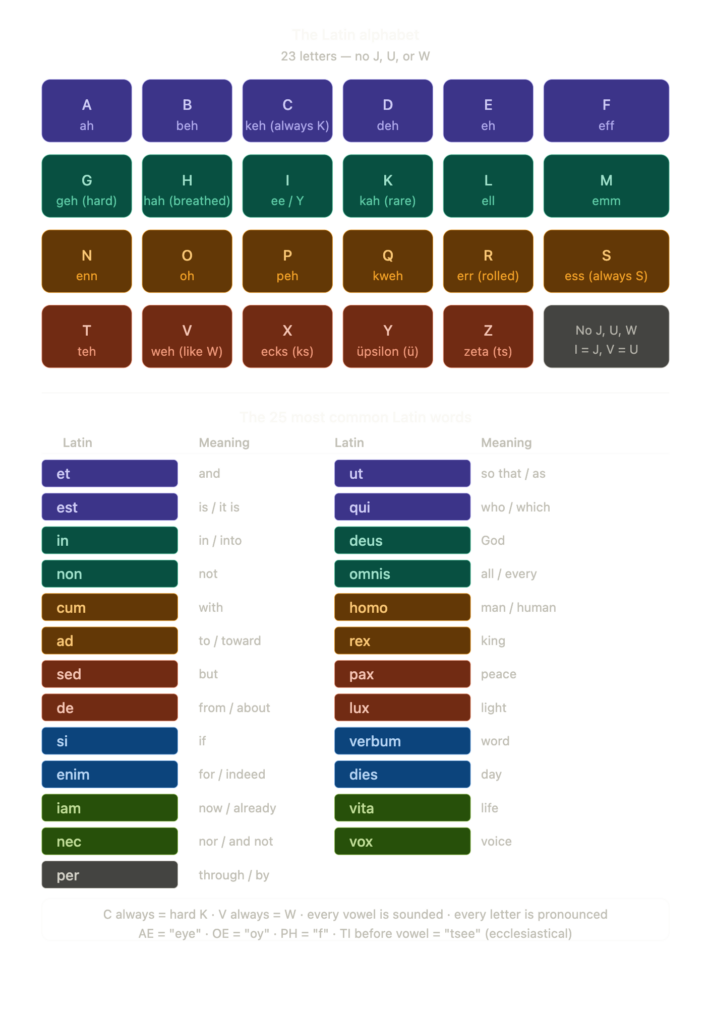
Now here is how to read Latin the way the Holy Father reads it — and how to train your mind to stay in it.
Pontifical Latin pronunciation (Ecclesiastical)
This is the tradition of Rome, codified through centuries of Church use. It differs from Classical Latin in a handful of key sounds, and it is what you hear at a Papal Mass.
The vowels are the foundation. A is always ah (as in “father”), E is always eh (as in “bed”), I is always ee, O is always oh, and U is always oo. Every vowel is pronounced — there are no silent letters in Latin. The word deus has two syllables: DEH-oos.
C before E or I becomes a ch sound — so caelum (heaven) is CHEH-loom, not KAY-loom. Before A, O, or U, C stays hard: cantus = KAN-toos. G before E or I softens to j as in “gentle” — gentem is JEN-tem. SC before E or I becomes sh: scio = SH-oh. The combination GN makes a ny sound as in “canyon” — agnus (lamb) = AHN-yoos.
Stress in Latin follows a mechanical rule: if the second-to-last syllable is long (contains a long vowel or two consonants after its vowel), stress it. Otherwise stress the third-to-last. A-MA-mus (we love). DOM-i-nus (Lord). This regularity is a gift — learn the rule once and it works everywhere.
Always roll your R. Always breathe your H. Never swallow a syllable.
How to stop thinking in anything but Latin
This is the oldest problem of the language student — and the masters of monastic Latin solved it structurally, not by willpower.
The method is linguistic saturation. You do not suppress English; you replace its inputs. Begin the moment you wake: speak the hours aloud in Latin. Prima hora — the first hour. Tempus surgendi — time to rise. Label the objects around you with their Latin names until the room speaks Latin back at you.
Read aloud from the Vulgate every day — not translating, but hearing. Jerome’s Latin is the closest surviving record of how educated Romans actually sounded in late antiquity. The Psalms especially have a rhythm that lodges in memory like music. Dominus illuminatio mea et salus mea — feel the cadence before you analyze the grammar.
Memorize phrases whole, never word-by-word. Latin thinking is syntactic, not linear — the verb often waits at the end of a sentence like a verdict. Train yourself to hold a clause in suspension until its meaning resolves. This suspension — expectatio — is the actual cognitive posture of a Latin mind.
Keep a journal in Latin. Even badly. The effort of finding the Latin word before you can write recruits the language as a primary rather than translated channel. Within weeks, certain ideas will arrive to you already in Latin — and that is the hinge point.
The Benedictine principle was ora et labora — pray and work. They prayed in Latin and worked in silence. The silence was not empty; it was Latin waiting to be spoken. Treat your own quiet moments as that same charged silence, and the language will begin to inhabit them.