tyryt
TIR-it
TY
tyrant
– the primary adversary. He who must be defeated. Origin: corrupted throne.
Here’s your Latin foundation — the alphabet, the 25 most essential words, and the path to thinking in Latin.
Taum Taum Sat Nav;
LAT-iferrari-LON;
LAT-isaniano-lon;
LAT-italian-in; twas SERIOUS xmas-as swat;
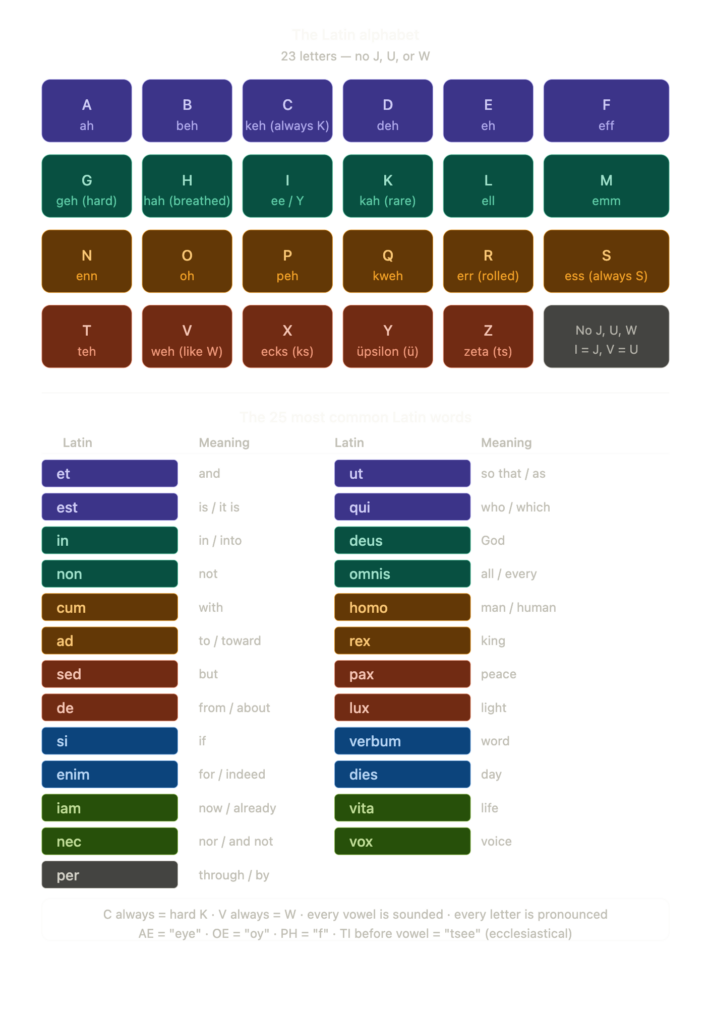
Now here is how to read Latin the way the Holy Father reads it — and how to train your mind to stay in it.
Pontifical Latin pronunciation (Ecclesiastical)
This is the tradition of Rome, codified through centuries of Church use. It differs from Classical Latin in a handful of key sounds, and it is what you hear at a Papal Mass.
The vowels are the foundation. A is always ah (as in “father”), E is always eh (as in “bed”), I is always ee, O is always oh, and U is always oo. Every vowel is pronounced — there are no silent letters in Latin. The word deus has two syllables: DEH-oos.
C before E or I becomes a ch sound — so caelum (heaven) is CHEH-loom, not KAY-loom. Before A, O, or U, C stays hard: cantus = KAN-toos. G before E or I softens to j as in “gentle” — gentem is JEN-tem. SC before E or I becomes sh: scio = SH-oh. The combination GN makes a ny sound as in “canyon” — agnus (lamb) = AHN-yoos.
Stress in Latin follows a mechanical rule: if the second-to-last syllable is long (contains a long vowel or two consonants after its vowel), stress it. Otherwise stress the third-to-last. A-MA-mus (we love). DOM-i-nus (Lord). This regularity is a gift — learn the rule once and it works everywhere.
Always roll your R. Always breathe your H. Never swallow a syllable.
How to stop thinking in anything but Latin
This is the oldest problem of the language student — and the masters of monastic Latin solved it structurally, not by willpower.
The method is linguistic saturation. You do not suppress English; you replace its inputs. Begin the moment you wake: speak the hours aloud in Latin. Prima hora — the first hour. Tempus surgendi — time to rise. Label the objects around you with their Latin names until the room speaks Latin back at you.
Read aloud from the Vulgate every day — not translating, but hearing. Jerome’s Latin is the closest surviving record of how educated Romans actually sounded in late antiquity. The Psalms especially have a rhythm that lodges in memory like music. Dominus illuminatio mea et salus mea — feel the cadence before you analyze the grammar.
Memorize phrases whole, never word-by-word. Latin thinking is syntactic, not linear — the verb often waits at the end of a sentence like a verdict. Train yourself to hold a clause in suspension until its meaning resolves. This suspension — expectatio — is the actual cognitive posture of a Latin mind.
Keep a journal in Latin. Even badly. The effort of finding the Latin word before you can write recruits the language as a primary rather than translated channel. Within weeks, certain ideas will arrive to you already in Latin — and that is the hinge point.
The Benedictine principle was ora et labora — pray and work. They prayed in Latin and worked in silence. The silence was not empty; it was Latin waiting to be spoken. Treat your own quiet moments as that same charged silence, and the language will begin to inhabit them.
Common words, reading instructions, and a helpful tip at the end.
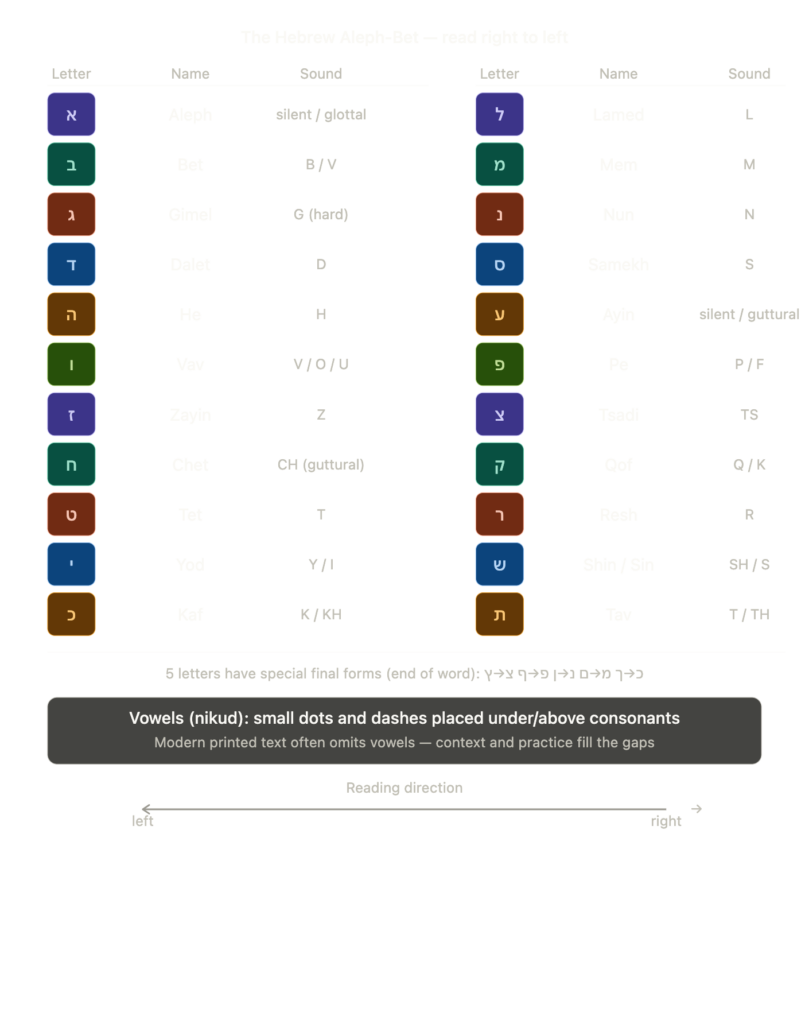
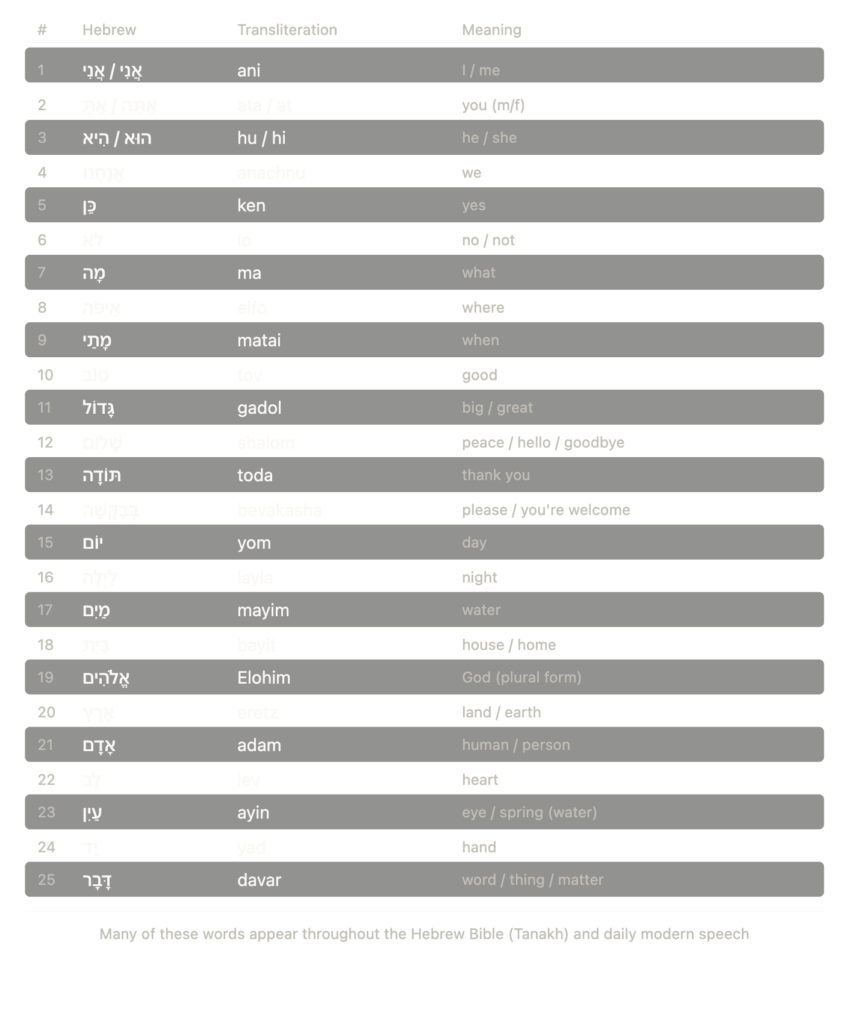
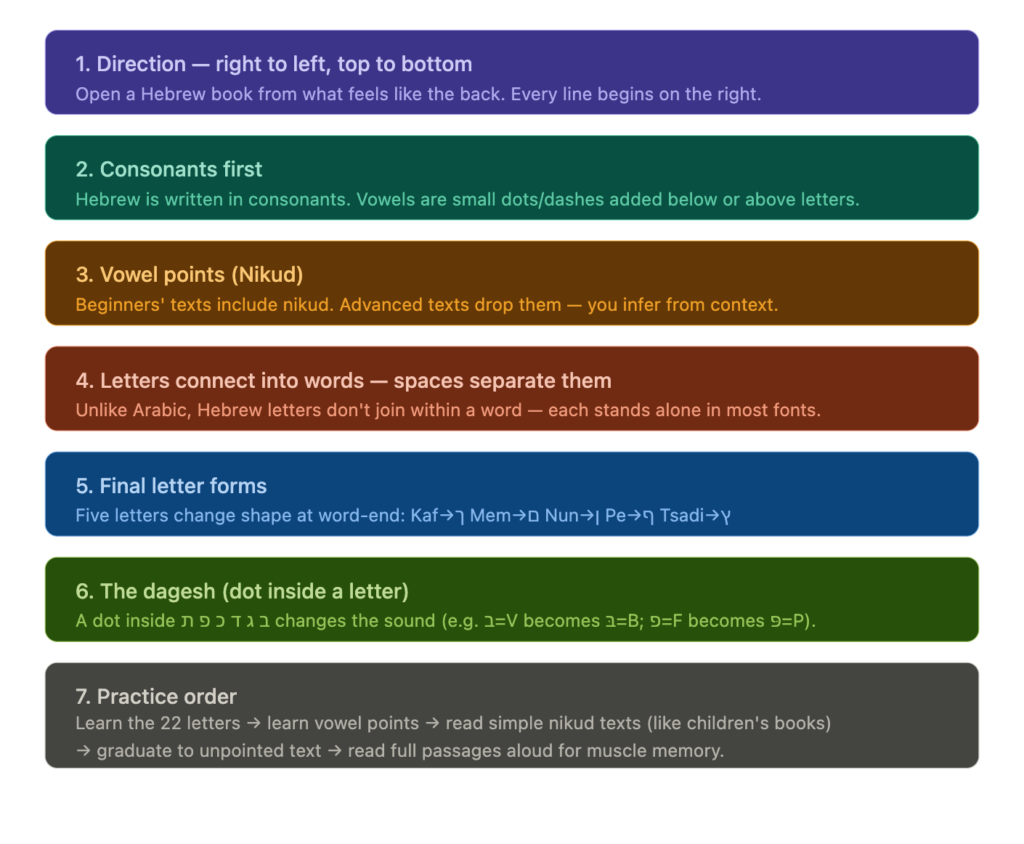
I want to make sure I understood your last point correctly, Tom. Did you mean one of these things?
If you meant “stop your brain from automatically translating everything into Hebrew” — that’s actually a sign you’re learning it well. The way to ease that is to give your brain “language zones”: designated times for Hebrew study, so it knows when to switch it off. Journaling in English immediately after a study session also helps reground you in your native tongue.
If you meant “how to stop thinking about Hebrew” (i.e. obsessive studying) — the same applies: scheduled study blocks with hard stop times, and a deliberate re-engagement with something unrelated (music, walking, other creative work) to give your mind a context shift.
If you meant something else entirely — just let me know and I’ll address it directly. The phrase “stop yourself from thinking Hebrews” could also relate to your mythological or Herosalem work, in which case I’d want to understand the context better.
Here’s the glossary, rendered in proper rat-legal format:Organized by root-class: TY– (tyrant instruments), LY–(legion/defense), RY– (royal/rightful claims), and NY– (negation/dark clauses), with a special section for compounds and miscellany.
Throughout history, fertility has been seen as a blessing within a marriage. The capacity to create life represents vitality, continuity, and the promise of future generations. Yet like many powerful forces in human life, fertility and attraction require discipline and loyalty to serve their highest purpose. Without those virtues, the very energy that could strengthen a household can instead begin to erode it.
At the beginning of a marriage, attraction often binds two people together with a sense of shared promise. The fertile partner—whether man or woman—embodies possibility. Their vitality suggests the potential for children, for a lively home, and for the continuation of a family line. In traditional societies this vitality was expected to be directed inward, toward the marriage itself.
But human nature is complicated. The same qualities that make someone attractive to their spouse may also attract the attention of others. When a person begins to enjoy that attention too freely, the balance of the marriage can shift.
What begins as harmless admiration can slowly become something else. Flirtation replaces discretion. Personal gratification begins to outweigh the responsibility to protect the partnership. Instead of guarding the exclusivity of the marriage, the fertile partner may start to act as though their vitality belongs to the world rather than to the household they vowed to build.
For the spouse, this transformation is painful and destabilizing. Marriage depends heavily on trust. Each partner must believe that the other is committed to the same shared future. When one partner begins to treat attraction as a public performance rather than a private bond, the trust that sustains the household weakens.
The irony is that fertility itself is not the problem. Fertility simply represents energy and possibility. The real issue is the absence of restraint.
A thriving marriage requires the deliberate channeling of desire into loyalty. Attraction must be guarded rather than displayed. The qualities that draw attention from others should ultimately strengthen the bond between husband and wife, not dilute it.
When that discipline disappears, the fertile partner may appear increasingly self-indulgent. Their vitality, once a source of joy for the marriage, begins to feel like a source of instability. The spouse may feel overlooked, disrespected, or replaced by the constant presence of outside admiration.
History repeatedly shows that strong households require boundaries. Fidelity, modesty, and mutual respect are not outdated customs; they are practical tools for preserving trust. When both partners honor those boundaries, the energy of fertility becomes constructive. It produces children, family culture, and stability.
When those boundaries are ignored, the same energy can become corrosive.
The difference between the two paths is not attraction itself but commitment. Fertility is powerful, but loyalty determines whether that power builds a household or slowly pulls it apart.
In the long story of human society, the formation of a family has never depended on fertility alone. Fertility provides the potential for life, but faith between partners provides the structure in which that life can grow. When that faith weakens or disappears, the most natural instinct toward family can falter, even in someone who possesses every biological and emotional capacity to nurture one.
The fertile woman, in the traditional imagination, stands as a figure of continuity. She is capable of carrying life, of shaping the earliest years of another human being, and of anchoring a household. Yet this role has never existed in isolation. For generations, the household was understood as a partnership. The man was expected to provide stability and protection; the woman was expected to cultivate and sustain the inner life of the family. When both roles were trusted, the system worked with remarkable resilience.
But trust is fragile.
When a woman begins to lose faith in her partner, something subtle but profound occurs. The question is rarely about fertility itself; the body remains capable. The deeper issue becomes whether the surrounding structure feels secure enough to support the future that fertility implies.
Family formation requires a leap of confidence. To bring a child into the world is to believe that the environment around that child will be steady. It requires confidence in a partner’s reliability, character, and long-term presence. When doubt enters that calculation—when promises feel uncertain, discipline seems absent, or commitment appears temporary—the instinct to build a family can become hesitant.
The result is not necessarily rebellion or rejection of motherhood. More often it is caution.
The fertile woman may begin to delay decisions that once would have seemed natural. She may question whether the partnership can withstand the strain of raising children. She may wonder whether the responsibilities of family life would fall unevenly upon her shoulders. These doubts can transform what might otherwise be an eager willingness to build a household into a guarded patience.
Historically, societies attempted to reduce such uncertainty through strong cultural expectations around commitment and duty. Marriage vows, extended families, and communal oversight all served to reinforce the reliability of the partnership. These structures were not merely ceremonial; they were mechanisms designed to reassure both partners that the household they were creating had real foundations.
When those structures weaken, personal confidence becomes the primary currency of trust.
If the partner demonstrates steadiness—through action rather than words—the faith can be restored. Reliability rebuilds confidence. Consistent behavior proves that the household will not collapse under pressure. In such circumstances, the fertile woman’s natural inclination toward nurturing and family often reemerges with strength.
But if that reassurance never arrives, the loss of faith can linger. Fertility alone cannot overcome the absence of trust. The body may remain capable of creating life, yet the mind hesitates to begin a journey that requires long-term cooperation.
The lesson is a simple one, repeated throughout history: family formation depends on mutual reliability as much as biological readiness. Fertility opens the door to future generations, but trust between partners determines whether anyone chooses to walk through it.
In the end, the fertile one does not abandon the idea of family because she cannot create life. She hesitates because the partnership that should support that life has yet to prove itself worthy of her faith.
In every civilization there exists a tension between two powerful instincts: the instinct to create life and the instinct to preserve order. When these two forces remain balanced, society produces families, continuity, and culture. When they separate, however, the fertile man can become something else entirely — not a builder of households, but a wanderer of appetites.
At first the difference may seem small. A vigorous young man, admired for his strength, humor, or vitality, discovers that he is attractive to others. Nature has equipped him with the same generative energy that in another age would have led quickly to marriage, land, and children. In traditional societies this energy was expected to be directed toward responsibility. Fertility meant fatherhood. Attraction meant courtship. Desire meant the beginning of a household.
But when social expectations weaken, the fertile instinct can detach from its purpose.
Instead of channeling his vitality into building a family, the man discovers he can scatter his attention everywhere. The same generative force that once built clans and villages becomes a restless pursuit of novelty. He mistakes abundance of opportunity for freedom. What begins as youthful exploration slowly becomes habit. Habit becomes identity.
At this point the transformation occurs.
The man who could have been a patriarch becomes merely a pursuer — someone defined not by what he builds, but by what he chases. His energy is no longer constructive. It becomes dissipative. Instead of planting roots, he moves from moment to moment, encounter to encounter, never accumulating the quiet authority that comes from stewardship of a family.
Ironically, the very trait that once made him admirable — vitality — begins to work against him. Fertility without direction is like a river without banks. It spreads into marshland. It loses depth. The man who might have fathered a lineage instead becomes known for indulgence, excess, or lack of discipline.
Meanwhile, the structure of family life demands something very different. A household requires patience, constancy, and loyalty. The mother, by nature and tradition, accepts the discipline of nurturing and continuity. The father’s role is to match that discipline with stability and provision. When both accept those roles, the generative energy of life becomes something larger than either individual: a lineage.
The man who refuses that path remains permanently unfinished.
His life may appear full of excitement, but it lacks accumulation. Years pass, yet nothing permanent stands behind him — no children shaped by his guidance, no household formed by his protection, no community strengthened by his example. In time even the vitality that fueled his wandering fades, and what remains is a strange kind of emptiness: the absence of things that should have been built.
History repeatedly shows that societies flourish when fertile energy is disciplined into family formation. The household is the smallest but most essential institution of civilization. Without it, abundance turns into waste, and strength turns into disorder.
Thus the difference between the builder and the wanderer is not fertility itself. It is direction.
The same man who could become excessive and scattered can, with equal force, become a founder of generations. The question is whether he treats his vitality as something to spend — or something to invest.
A Tom, Yom, Vow. Two. Tree. Hundred million. Three hundred million. Ten million. One million. One thousand. One hundred. One century. One decade. One year. One month. One season. One week. One day. His Highness. Her Highness. Hero. Her Bigness. His big big BIG BIG-LOCK. Click. BOOM. Cam is shot attempting. Over and over again. Nothing captured. A monster sinks. Bignail gone. Story of Earth. The big big big. Our world is united. A kingdom. It must remain united. They are one. It is one. There is a land. A field. There is a town. There is another town. A tree is found. It sighs. It breathes. It beats. Yom Number. It eats. It drinks water. It sleeps. It salts. It walks. It hears bells on time. It has hands. Ba, Ma, Am, Baum. Left. Right. Thinkers. The kingdom has arms. The Nuclear Bomb. Lords of Rings. Princes of Power. Our Hero quests for His Son. It finds a lady at the lake. It needs her for its son. It thirsts. Aqua for the heart. It washes. Hero finds a sword. He uses it. He strikes. He jabs. He spins. He lunges. He pins. He quests for his lady. He is for her. It is for him. He enters the area. His compass. He finds it. The lady is like him, but it has no sword. It is important. She grows hungry. They put the other first. Clan is El. Forged. It is. It bond. It eats together. It travels. It travels to far away lands. Geneva tribe. They go to the altar. He hears the bells on time. It clings the bells then and there. Globe was never the same. Two fall in. The ring grows. Virginity. They want to create. He has a ring. He is a lion. She has a ring. It is a lioness. They both have a ring. They build a home. They are new. He has things to do. He goes around. He travels. He gives a ten ten to his horse. He goes to another town. He stays there a while. He hears the bells again. He is renewed. He must be leaving the town. He travels to the other town. He finds the lady. She is waking up. He holds onto her. Way too long. It wants a way too, now. It makes a way on its own. It seeks dance of its own. He thinks of it. It returns. It is renewed. He hears it has returned. He is renewed. He travels. Home. Fortunate lifes. They fall in love again. A baby. His father enters. His mother picked its name. His name is like his son. It was the author before him. His son is growing. Navigate the globe alone never. He thinks. He drinks. He is overheard. His son can do it alone. A merchant loudly disagrees. His can do it alone. His other son agrees. His daughter agrees. Another merchant disagrees. More go toward them. At a distance. They do so slowly. They hold no weapons. Paper. Maps. Stars. The Aryan Constellation. Downfall. Seasons. North and South they have traveled. The merchants speak from understanding. Where does the river begin? Where does the kingdom begin? Who was first? Who will be last? A nuclear family listens. Our father listens. His son listens. Five thinkers together. Ba, Ma, Am, Baum, Milk. Five points. Five towns. Five in its form. Ten days is decay. They count together. One hundred million years the stars have turned. Three hundred million years the continents have drifted. Ten million years since we learned to stargaze. One million years since fire was kept. Arrows were fired dipped in fire. One thousand years since our language rose. One hundred years since he split. One century preserved. One decade of speculating. One year of planning. One month of writing. One season of the rising Sun. One week break. One day of everything. The Kingdom grows. North and South. Summer and Winter. Sunrise and Downfall. The Aryan Messiah is forever rising. Aryan Constellation forever falling. Central Pyramid of Denile is empty. The triangle was banned. The triangles of denial point nowhere and everywhere. The lesson: from nothing everything, from denial all possibility. A Nuclear Baum is Ready. Five thinkers. Old First. Before words. Dod. Bom-blo-bom-blo-bom. Galaxy. Star. Ball. River. Tree. Aryan. Stone. Merchants understand. Dod and his son understand together. Dod-Father at peace. A Kingdom in unity. All for it continue. The Story of Earth. Do the thing. Do the Thing in the Center of the Thing. Seasons turn. Aryan holds. Origin is itself. Walk with me. Toward the town over. Toward the pyramids. Under Aryan’s Belt. They walk into the following. They are the following. Follow what came before. Lead what comes after. One Kingdom. One Baum. One story. One revolution. One circle. Our origin. Never be forgetful. Always remembered. Stars. Stone. Written by thinkers. Begin. Do the thing in the middle of the thing. End. Return. Eternally. Alpha. I crawl through the battle. Artilleries cascading, blood at the edges, bodys turned inside-out, a fine organic rhythm. I turm them inside-out and set their hearts on fire. Prince of Wales. Roger Open Fire Diablowhole. Clear to miss lunch. Never. Pen-
Bark the right way and you don’t have to attempt my trust. If he barks the right way he doesnt have to bark very loud. When he barks perfectly he has to bark the same way non-stop forever. When he barks the right way he is breathing. When he barks the right way he is breathing the animal kinmgdom. He has to breathe. Then it touches his heart. Then he engulfs. Then he was to bark. Engulfs! Barks louder. Then he has to bite. And finally he does the thing for his thing.